> For the complete documentation index, see [llms.txt](https://docs.nara.stream/llms.txt). Markdown versions of documentation pages are available by appending `.md` to page URLs; this page is available as [Markdown](https://docs.nara.stream/using-the-app-core-features/projects/project-settings.md).
# Project Settings
Each project has settings which control the users which have access to that project, media rules which can be automatically applied, the end-to-end colour workflow and the project's media 'container'
These settings are detailed below (note that you can close the settings by clicking on the **◀Project** button at the top left corner of the window):
### Project Members
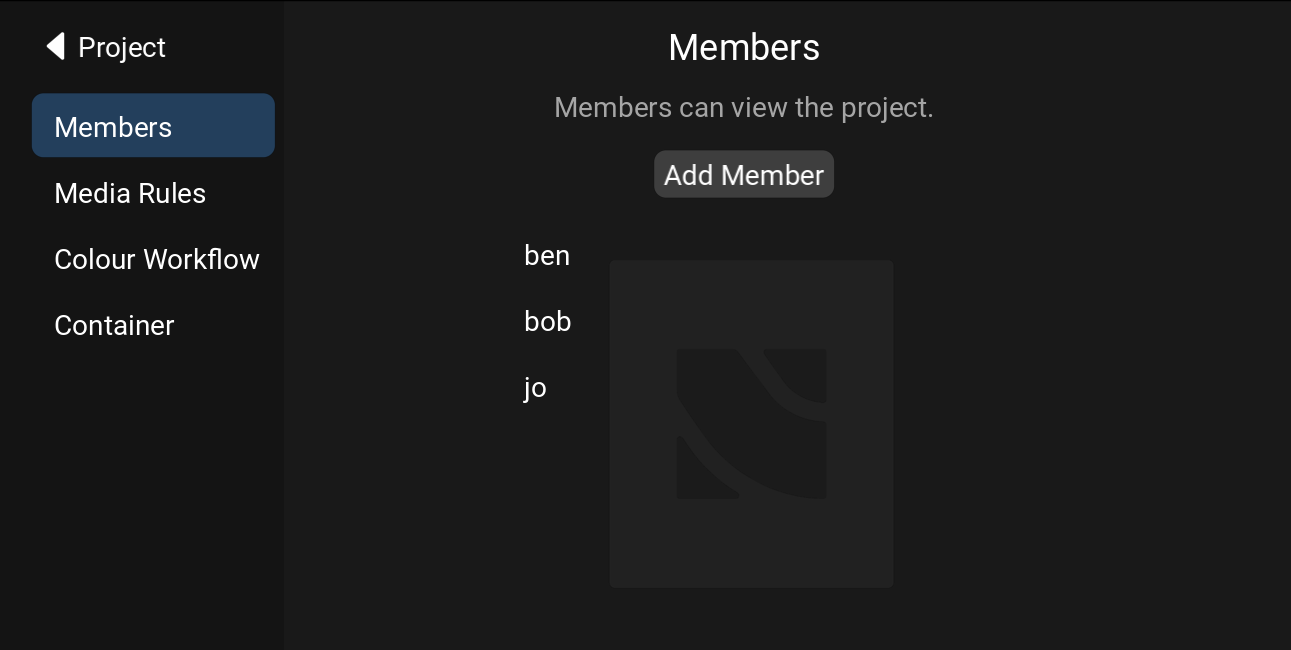
When the **Members** button is enabled you will see a list of the users who currently have access to this project. Click on the **Add Member** button to add extra users to the project. Note that the list of users who can be added and the permissions controlling what they can do within the project are controlled by the system adimistrator. See the section on User Permissions for more details.
### Media Rules
Media rules can be defined to set up or modify specific parameters for one or more media files within your project. For example you can create a rule to set all R3D files to be decoded a maximum quality or apply all embedded LUTs from a specific camera.
Selecting the **Media Rules** button in the Project settings allows you to inspect any existing rules and create new ones. See the section on [media rules](/advanced-features/media-rules.md) for more details.
### Colour Workflow
Clicking on the Colour Workflow button in the Project Settings will bring up the following window:
The two drop-down buttons allow you to select the Display Rendering Transform or DRT for this project. Several options are available including 'ACES RRT' ARRI REVEAL' and 'Truelight CAM'. Each DRT can be applied according to different viewing conditions such as 'Cinema 48nits' 'Office 100nits' and 'VideoWide 1000nits'. Choose the appropriate DRT for your project's overall colour workflow and the viewing environment for your display.
### Container
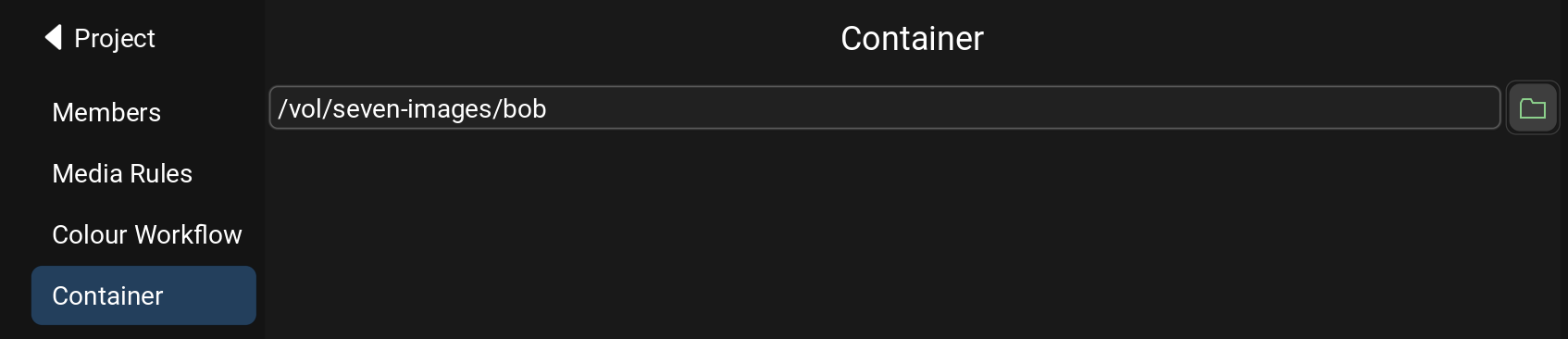
The project 'container' is the default directory or folder for media storage. It is used as the default location for consolidated or transcoded media files:
You can change the container's path by clicking on the green folder icon - this will open a browser window allowing you to choose any folder you have access to within the media storage system. Note that the folder you choose may not provide write access for your user - please refer to the [Consolidate & Transcode](/advanced-features/consolidate-and-transcode.md) section for further information.